A Twentiethcentury Sculptor Known for Exploring Open and Closed Forms in His Art Is
| Henry Moore OM CH FBA | |
|---|---|
 Moore in 1975 | |
| Born | Henry Spencer Moore (1898-07-xxx)xxx July 1898 Castleford, West Riding of Yorkshire, England |
| Died | 31 August 1986(1986-08-31) (anile 88) Much Hadham, Hertfordshire, England |
| Education | Leeds School of Fine art Majestic College of Fine art |
| Known for | Sculpture, cartoon, graphics, textiles |
| Notable work | Reclining Figures, 1930s–1980s |
| Move | Bronze Sculpture, Modernism |
Henry Spencer Moore OM CH FBA (30 July 1898 – 31 August 1986) was an English language artist. He is all-time known for his semi-abstract monumental bronze sculptures which are located effectually the world as public works of fine art. Likewise as sculpture, Moore produced many drawings, including a serial depicting Londoners sheltering from the Blitz during the Second World War, along with other graphic works on paper.
His forms are ordinarily abstractions of the homo figure, typically depicting mother-and-kid or reclining figures. Moore's works are usually suggestive of the female person torso, apart from a phase in the 1950s when he sculpted family groups. His forms are generally pierced or contain hollow spaces. Many interpreters liken the undulating form of his reclining figures to the landscape and hills of his Yorkshire birthplace.
Moore became well known through his carved marble and larger-scale abstract cast bronze sculptures, and was instrumental in introducing a particular grade of modernism to the United kingdom of great britain and northern ireland. His power in later life to fulfil big-scale commissions made him exceptionally wealthy. Despite this, he lived frugally; well-nigh of the money he earned went towards endowing the Henry Moore Foundation, which continues to support education and promotion of the arts.
Life [edit]
Early life [edit]
Moore was born in Castleford, W Riding of Yorkshire, England, to Mary (née Bakery) and Raymond Spencer Moore. His father was Irish and became pit deputy and so under-director of the Wheldale colliery in Castleford. He was an autodidact with an involvement in music and literature. Determined that his sons would not work in the mines, he saw formal instruction as the route to their advancement.[i] Henry was the seventh of eight children in a family that often struggled with poverty. He attended babe and elementary schools in Castleford, where he began modelling in clay and etching in woods. He professed to have decided to become a sculptor when he was eleven later on hearing of Michelangelo'south achievements at a Sunday School reading.[2]
On his 2nd attempt he was accustomed at Castleford Secondary School, which several of his siblings had attended, where his headmaster before long noticed his talent and interest in medieval sculpture.[3] His fine art instructor, Alice Gostick, broadened his knowledge of art, and with her encouragement, he determined to make art his career; offset by sitting for examinations for a scholarship to the local art college.[4] Moore'southward earliest recorded carvings – a plaque for the Scott Society at Castleford Secondary Schoolhouse, and a Curl of Laurels commemorating the boys who went to fight in the Outset Earth War from the schoolhouse – were executed effectually this time.[5]
Despite his early promise, Moore's parents had been against him training as a sculptor, a vocation they considered manual labour with few career prospects. After a brief introduction as a student instructor, Moore became a teacher at the school he had attended.[4] Upon turning 18, Moore volunteered for ground forces service in the First World War. He was the youngest man in the Prince of Wales' Ain Civil Service Rifles regiment and was injured in 1917 in a gas attack, on thirty November at Bourlon Wood,[6] during the Battle of Cambrai.[7] After recovering in infirmary, he saw out the residuum of the war as a physical training instructor, but returning to France equally the Armistice was signed. He recalled afterwards, "for me the war passed in a romantic haze of trying to be a hero."[8] This attitude changed as he reflected on the destructiveness of state of war and in 1940 he wrote, in a letter to his friend Arthur Sale, that "a yr or two after [the war] the sight of a khaki uniform began to mean everything in life that was wrong and wasteful and anti-life. And I still take that feeling."[ix]
Ancestry equally a sculptor [edit]
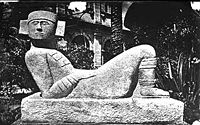

Moore'due south reclining figures, such as the 1930 Reclining Woman (bottom), were influenced by Chac Mool figures, such as this 1 (pinnacle) from Chichen Itza.
After the war, Moore received an ex-serviceman's grant to continue his didactics and in 1919 he became a student at the Leeds Schoolhouse of Fine art (now Leeds Arts University), which set up a sculpture studio especially for him. At the college, he met Barbara Hepworth, a fellow student who would likewise get a well-known British sculptor, and began a friendship and gentle professional rivalry that lasted for many years. In Leeds, Moore likewise had admission to the modernist works in the collection of Sir Michael Sadler, the University Vice-Chancellor, which had a pronounced outcome on his development.[10] In 1921, Moore won a scholarship to written report at the Purple College of Fine art in London, along with Hepworth and other Yorkshire contemporaries.[xi] While in London, Moore extended his knowledge of primitive art and sculpture, studying the ethnographic collections at the British Museum.[12]
The student sculptures of both Moore and Hepworth followed the standard romantic Victorian style, and included natural forms, landscapes and figurative modelling of animals. Moore later became uncomfortable with classically derived ideals; his subsequently familiarity with primitivism and the influence of sculptors such as Constantin Brâncuși, Jacob Epstein, Henri Gaudier-Brzeska and Frank Dobson led him to the method of straight carving, in which imperfections in the material and marks left by tools became part of the finished sculpture. Having adopted this technique, Moore was in conflict with bookish tutors who did non capeesh such a mod approach. During 1 exercise set up by Derwent Wood (the professor of sculpture at the Royal Higher), Moore was asked to reproduce a marble relief of Domenico Rosselli's The Virgin and Kid [13] by first modelling the relief in plaster, so reproducing it in marble using the mechanical assistance known as a "pointing machine", a technique called "pointing". Instead, he carved the relief direct, even marker the surface to simulate the prick marks that would have been left past the pointing machine.[14]
In 1924, Moore won a half dozen-month travelling scholarship which he spent in Northern Italia studying the neat works of Michelangelo, Giotto di Bondone, Giovanni Pisano and several other Quondam Masters. During this period he besides visited Paris, took reward of the timed-sketching classes at the Académie Colarossi, and viewed, in the Trocadero, a plaster cast of a Toltec-Maya sculptural course, the Chac Mool, which he had previously seen in volume illustrations. The reclining figure was to have a profound upshot upon Moore's piece of work, becoming the primary motif of his sculpture.[15]
Hampstead [edit]
On returning to London, Moore undertook a seven-year teaching post at the Regal College of Fine art. He was required to work two days a week, which allowed him time to spend on his own piece of work. His offset public committee, West Wind (1928–29), was i of the eight reliefs of the 'four winds' high on the walls of London Underground'due south headquarters at 55 Broadway.[16] The other 'winds' were carved past contemporary sculptors including Eric Gill with the ground-level pieces provided past Epstein. 1928 saw Moore'south first solo exhibition, held at the Warren Gallery in London.[17] On 19 July 1929, Moore married Irina Radetsky, a painting pupil at the Royal College.[18] Irina was born in Kiev in 1907. Her father was killed in the Russian Revolution and her female parent was evacuated to Paris where she married a British ground forces officer. Irina was smuggled to Paris a year later and went to schoolhouse there until she was 16, after which she was sent to live with her stepfather'south relatives in Buckinghamshire.[19]

Irina found security in her marriage to Moore and was soon posing for him. Before long after they married, the couple moved to a studio in Hampstead at 11a Parkhill Road NW3, joining a minor colony of avant-garde artists who were taking root there. Shortly later on, Hepworth and her 2nd husband Ben Nicholson moved into a studio around the corner from Moore, while Naum Gabo, Roland Penrose, Cecil Stephenson and the art critic Herbert Read also lived in the area (Read referred to the area equally "a nest of gentle artists").[20] The expanse was also a stopping-off signal for many refugee artists, architects and designers from continental Europe en route to America.[21]
In 1932, after six-yr's educational activity at the Royal College, Moore took up a postal service as the Head of the Department of Sculpture at the Chelsea School of Fine art.[22] Artistically, Moore, Hepworth and other members of The 7 and Five Society would develop steadily more than abstract piece of work,[23] partly influenced past their frequent trips to Paris and their contact with leading progressive artists, notably Pablo Picasso, Georges Braque, Jean Arp and Alberto Giacometti. Moore flirted with Surrealism, joining Paul Nash's modern art movement "Unit One", in 1933. In 1934, Moore visited Spain; he visited the cave of Altamira (which he described as the "Majestic Academy of Cave Painting"), Madrid, Toledo and Pamplona.[24]
In 1936, Moore joined a group of surrealist artists founded by Roland Penrose, and the same twelvemonth was honorary treasurer to the organising committee of the London International Surrealist Exhibition.[25] In 1937, Roland Penrose purchased an abstract 'Mother and Kid' in stone from Moore that he displayed in the front end garden of his house in Hampstead. The work proved controversial with other residents and the local press ran a entrada against the piece over the next two years. At this time Moore gradually transitioned from directly carving to casting in bronze, modelling preliminary maquettes in clay or plaster rather than making preparatory drawings.[ citation needed ]
In 1938, Moore met Kenneth Clark for the first fourth dimension.[26] From this time, Clark became an unlikely just influential champion of Moore'due south work,[27] and through his position as member of the Arts Council of Britain he secured exhibitions and commissions for the artist.[28]
Second Globe War [edit]

Women and Children in the Tube (1940) (Fine art.IWM Fine art LD 759)
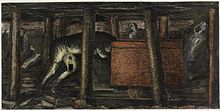
At the Coal Confront. A Miner Pushing a Tub (1942) (Art.IWM ART LD 2240)
At the outbreak of the Second World War the Chelsea School of Art was evacuated to Northampton and Moore resigned his teaching post. During the war, Moore produced powerful drawings of Londoners sleeping in the London Underground while sheltering from the Blitz.[29] Kenneth Clark, the chairman of the War Artists' Advisory Committee (WAAC), had previously tried to recruit Moore equally a total-fourth dimension salaried state of war artist and now agreed to purchase some of the shelter drawings and issued contracts for further examples. The shelter drawings WAAC acquired were completed betwixt the autumn of 1940 and the spring of 1941 and are regarded as amongst the finest products of the WAAC scheme.[30] In August 1941 WAAC deputed Moore to describe miners working hole-and-corner at the Wheldale Colliery in Yorkshire, where his begetter had worked at the start of the century. Moore drew the people in the shelters equally passively waiting the all-articulate while miners aggressively worked the coal-faces.[31] These drawings helped to boost Moore'southward international reputation, particularly in America where examples were included in the WAAC Britain at War exhibition which toured North America throughout the war.[30]
Afterward their Hampstead domicile was hit by bomb shrapnel in September 1940, Moore and Irina moved out of London to live in a farmhouse called Hoglands in the hamlet of Perry Green almost Much Hadham, Hertfordshire.[32] This was to become Moore'south home and workshop for the balance of his life. Despite acquiring significant wealth after in life, Moore never felt the need to move to larger bounds and, apart from the addition of a number of outbuildings and studios, the house inverse piffling over the years. In 1943 he received a committee from St Matthew's Church, Northampton, to cleave a Madonna and Child; this sculpture was the first in an important series of family-group sculptures.[33]
Later years [edit]


After the war and following several earlier miscarriages, Irina gave birth to their daughter, Mary Moore, in March 1946.[34] The child was named after Moore's mother, who had died two years before. Both the loss of his mother and the arrival of a baby focused Moore's mind on the family unit, which he expressed in his work by producing many "female parent-and-child" compositions, although reclining and internal/external figures as well remained pop. In the same year, Moore fabricated his first visit to America when a retrospective exhibition of his piece of work opened at the Museum of Modern Art in New York City.[35]
Before the state of war, Moore had been approached by educator Henry Morris, who was trying to reform didactics with his concept of the Village Higher. Morris had engaged Walter Gropius as the architect for his second hamlet college at Impington nigh Cambridge, and he wanted Moore to design a major public sculpture for the site. The Canton Council, however, could not afford Gropius'due south full design, and scaled dorsum the project when Gropius emigrated to America. Lacking funds, Morris had to cancel Moore's sculpture, which had not progressed beyond the maquette stage.[36] Moore was able to reuse the design in 1950 for a similar commission exterior a secondary schoolhouse for the new town of Stevenage. This fourth dimension, the project was completed and Family unit Group became Moore's first large-scale public bronze.[37]

The UNESCO slice being moved, in 1963, to permit for edifice work
In the 1950s, Moore began to receive increasingly pregnant commissions. He exhibited Reclining Figure: Festival at the Festival of United kingdom of great britain and northern ireland in 1951,[38] and in 1958 produced a big marble reclining figure for the UNESCO building in Paris.[39] With many more public works of art, the scale of Moore's sculptures grew significantly and he started to employ an increasing number of assistants to work with him at Much Hadham, including Anthony Caro[40] and Richard Wentworth.[41]
On the campus of the Academy of Chicago in December 1967, 25 years to the minute[42] after the squad of physicists led by Enrico Fermi achieved the first controlled, self-sustaining nuclear chain reaction, Moore's Nuclear Free energy was unveiled on the site of what was one time the university'due south football field stands, in the rackets court beneath which the experiments had taken place.[43] This 12-human foot-tall piece in the centre of a large, open plaza is frequently thought to represent a mushroom cloud topped past a massive homo skull, but Moore's interpretation was very different. He one time told a friend that he hoped viewers would "go around information technology, looking out through the open spaces, and that they may take a feeling of beingness in a cathedral."[44] In Chicago, Illinois, Moore too commemorated science with a large statuary sundial, locally named Human Enters the Creation (1980), which was commissioned to recognise the space exploration plan.[45]

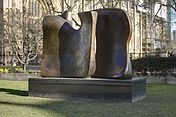
The terminal iii decades of Moore's life connected in a similar vein; several major retrospectives took identify around the world, notably a very prominent exhibition in the summer of 1972 in the grounds of the Forte di Belvedere overlooking Florence. Following the pioneering documentary 'Henry Moore', produced by John Read in 1951, he appeared in many films. In 1964, for instance, Moore was featured in the documentary "5 British Sculptors (Work and Talk)" by American filmmaker Warren Forma. Past the end of the 1970s, at that place were some forty exhibitions a year featuring his piece of work. The number of commissions continued to increase; he completed Knife Edge Two Piece in 1962 for College Dark-green near the Houses of Parliament in London. According to Moore, "When I was offered the site near the House of Lords ... I liked the identify so much that I didn't carp to get and meet an alternative site in Hyde Park—ane alone sculpture can be lost in a large park. The Firm of Lords site is quite different. It is side by side to a path where people walk and it has a few seats where they can sit down and contemplate information technology."[46]
As his wealth grew, Moore began to worry most his legacy. With the help of his daughter Mary, he prepare the Henry Moore Trust in 1972, with a view to protecting his estate from death duties. Past 1977, he was paying close to a million pounds a year in income tax; to mitigate his tax burden, he established the Henry Moore Foundation equally a registered clemency with Irina and Mary equally trustees. The Foundation was established to encourage the public appreciation of the visual arts and specially the works of Moore. Information technology at present runs his business firm and estate at Perry Green, with a gallery, sculpture park and studios.[47]
In 1979 Henry Moore became unexpectedly known in Germany when his sculpture Large 2 Forms was installed in the forecourt of the High german Chancellery in Bonn, which was the upper-case letter urban center of West Germany prior to German reunification in October 1990.[48]
Moore died on 31 August 1986 at his home in Perry Green. His torso was interred at the churchyard of St Thomas's Church building.[49]

The Art Gallery of Ontario's Henry Moore collection is the largest public collection of his works in the earth
.
Style [edit]

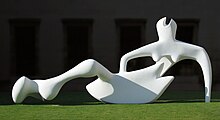
Moore's signature form is a reclining figure. Moore's exploration of this form, nether the influence of the Toltec-Mayan figure he had seen at the Louvre, was to atomic number 82 him to increasing brainchild equally he turned his thoughts towards experimentation with the elements of design. Moore's earlier reclining figures bargain principally with mass, while his subsequently ones contrast the solid elements of the sculpture with the space, not only round them but generally through them as he pierced the forms with openings.[ citation needed ]
Earlier figures are pierced in a conventional manner, in which bent limbs separate from and rejoin the torso. The subsequently, more abstruse figures are oft penetrated past spaces directly through the body, by which means Moore explores and alternates concave and convex shapes. These more farthermost piercings developed in parallel with Barbara Hepworth'south sculptures.[fifty] Hepworth commencement pierced a body after misreading a review of one of Henry Moore's early shows. The plaster Reclining Effigy: Festival (1951) in the Tate, is characteristic of Moore'due south later on sculptures: an abstruse female person figure intercut with voids. As with much of the post-State of war work, there are several bronze casts of this sculpture. When Moore's niece asked why his sculptures had such simple titles, he replied,
All art should have a sure mystery and should make demands on the spectator. Giving a sculpture or a drawing likewise explicit a title takes away function of that mystery and then that the spectator moves on to the next object, making no endeavour to ponder the meaning of what he has just seen. Everyone thinks that he or she looks but they don't really, you know.[51]
Moore's early on piece of work is focused on straight carving, in which the course of the sculpture evolves as the artist repeatedly whittles away at the block. In the 1930s, Moore'due south transition into modernism paralleled that of Barbara Hepworth; the two exchanged new ideas with each other and several other artists then living in Hampstead. Moore fabricated many preparatory sketches and drawings for each sculpture. Near of these sketchbooks have survived and provide insight into Moore's evolution. He placed great importance on drawing; in old historic period, when he had arthritis, he continued to describe.[52]

Wall Relief No. i, (1955), Bouwcentrum, Rotterdam
After the Second World War, Moore's bronzes took on their larger scale, which was especially suited for public fine art commissions. Every bit a matter of practicality, he largely abandoned direct carving, and took on several assistants to help produce the larger forms based on maquettes. By the end of the 1940s, he produced sculptures increasingly by modelling, working out the shape in clay or plaster before casting the terminal work in bronze using the lost wax technique. These maquettes often began as minor forms shaped past Moore'due south hands—a process that gives his work an organic feeling. They are from the body. At his abode in Much Hadham, Moore built up a collection of natural objects; skulls, driftwood, pebbles, rocks and shells, which he would use to provide inspiration for organic forms. For his largest works, he usually produced a half-scale, working model earlier scaling up for the terminal moulding and casting at a bronze foundry. Moore frequently refined the final full plaster shape and added surface marks earlier casting.[ citation needed ]
Moore produced at to the lowest degree three significant examples of architectural sculpture during his career. In 1928, despite his own cocky-described "farthermost reservations", he accepted his start public committee for Due west Air current for the London Hole-and-corner Building at 55 Broadway in London, joining the visitor of Jacob Epstein and Eric Gill.[53] In 1953, he completed a four-role physical screen for the Time-Life Edifice in New Bail Street, London,[54] and in 1955 Moore turned to his starting time and merely work in carved brick, "Wall Relief" at the Bouwcentrum in Rotterdam. The brick relief was sculpted with 16,000 bricks by two Dutch bricklayers under Moore'due south supervision.[ citation needed ]
The aftermath of World War II, The Holocaust, and the age of the diminutive flop instilled in the sculpture of the mid-1940s a sense that art should render to its pre-cultural and pre-rational origins. In the literature of the 24-hour interval, writers such as Jean-Paul Sartre advocated a similar reductive philosophy.[55] At an introductory speech in New York Metropolis for an exhibition of one of the finest modernist sculptors, Alberto Giacometti, Sartre spoke of "The beginning and the stop of history".[56] Moore'south sense of England emerging undefeated from siege led to his focus on pieces characterised past endurance and continuity.[55]
Legacy [edit]

Most sculptors who emerged during the height of Moore'southward fame, and in the aftermath of his expiry, found themselves bandage in his shadow. By the belatedly 1940s, Moore was a worldwide celebrity; he was the phonation of British sculpture, and of British modernism in general. The next generation was constantly compared against him, and reacted by challenging his legacy, his "establishment" credentials and his position. At the 1952 Venice Biennale, 8 new British sculptors produced their Geometry of Fear works as a directly dissimilarity to the ethics behind Moore's idea of Endurance, Continuity;[57] his large bronze Double Standing Effigy stood outside the British pavilion, and contrasted strongly with the rougher and more angular works within.[58]
Nevertheless Moore had a direct influence on several generations of sculptors of both British and international reputation. Amidst the artists who have acknowledged Moore'due south importance to their work are Sir Anthony Caro,[59] Phillip King[60] and Isaac Witkin,[61] all three having been assistants to Moore. Other artists whose work was influenced by him include Helaine Blumenfeld, Drago Marin Cherina, Lynn Chadwick, Eduardo Paolozzi, Bernard Meadows, Reg Butler, William Turnbull, Robert Adams, Kenneth Armitage, and Geoffrey Clarke.[62]
Henry Moore Foundation helps to preserve his legacy by supporting sculptors and creating exhibitions, its goal is to develop appreciation for visual arts. The Foundation was established past Henry and his family in 1977 in England, and still working.[63]
Controversy [edit]
In December 2005, the two ton Reclining Figure (1969–70) – insured for £3 million – was lifted by crane from the grounds of the Henry Moore Foundation on to a lorry and has non been recovered.[64] Two men were jailed for a twelvemonth in 2012 for stealing a sculpture called Sundial (1965) and the bronze plinth of another piece of work, as well from the foundation's estate.[65] In October 2013 Standing Figure (1950), one of four Moore pieces in Glenkiln Sculpture Park, estimated to be worth £3 1000000, was stolen.[65] [66]
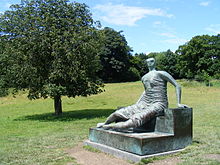
In 2012, the quango of the London Civic of Tower Hamlets appear its plans to sell another version of Draped Seated Adult female 1957–58, a 1.6-tonne bronze sculpture.[67] Moore, a well-known socialist, had sold the sculpture at a fraction of its market value to the one-time London County Council on the understanding that it would be displayed in a public space and might enrich the lives of those living in a socially deprived surface area. Nicknamed Old Flo, it was installed on the Stifford council estate in 1962 but was vandalised and moved to the Yorkshire Sculpture Park in 1997. Belfry Hamlets Quango afterward had considered moving Draped Seated Woman to individual land in Canary Wharf but instead chose to "explore options" for a sale.[68] In response to the proclamation an open letter was published in The Guardian, signed past Mary Moore, the artist'southward girl, by Sir Nicholas Serota, Manager of the Tate Gallery, by filmmaker Danny Boyle, and past artists including Jeremy Deller. The letter said that the sale "goes against the spirit of Henry Moore'southward original sale" of the work.[69]
Popular interest [edit]
Today, the Henry Moore Foundation manages the artist's erstwhile habitation at Perry Green in Hertfordshire as a visitor destination, with lxx acres of sculpture grounds equally well as his restored house and studios. It also runs the Henry Moore Found in Leeds which organises exhibitions and inquiry activities in international sculpture. Popular interest in Moore's piece of work was perceived past some to have declined for a while in the Uk but has been revived in recent times past exhibitions including at Kew Gardens in 2007, Tate Britain in 2010, and Hatfield House in 2011. The Foundation he endowed continues to play an essential part in promoting contemporary art in the United kingdom of great britain and northern ireland and abroad through its grants and exhibitions programme.[70]
Collections [edit]
England [edit]
The world's largest collection of Moore's work is open to the public and is housed in the house and grounds of the 60-acre estate, that was Moore's abode for 40 years, in Perry Green in Hertfordshire . The site and the collection are now owned by the Henry Moore Foundation.[71]
In December 2005, thieves entered a courtyard at the Henry Moore Foundation and stole a cast of Moore's Reclining Figure 1969–lxx (LH 608) – a 3.6 metre-long, two.1-tonne bronze sculpture. Closed-circuit-television footage showed that they used a crane to lower the piece onto a stolen flatbed truck. A substantial advantage was offered past the Foundation for information leading to its recovery. By May 2009, after a thorough investigation, British officials said they believe the work, in one case valued at £iii million was probably sold for chip metal, fetching near £5,000.[72] [73] In July 2012 the 22 inches (56 cm) statuary Sundial 1965, valued at £500,000, was stolen from the Moore Foundation.[74] Subsequently that twelvemonth, following the details of the theft beingness publicised on the BBC Crimewatch tv set program, the work was recovered, and the thieves were sentenced to twelve months' custody.[75]
Moore presented 36 sculptures, every bit well as drawings, maquettes and other works to the Tate Gallery in 1978.[76]
Toronto [edit]
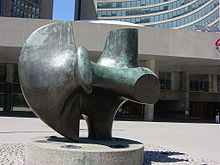
The Henry Moore Sculpture Centre in the Art Gallery of Ontario, Toronto, opened in 1974. It comprises the earth's largest public collection of Moore's piece of work, well-nigh of it donated past him between 1971 and 1974. Moore's Three Way Piece No. ii (The Archer) has likewise been on brandish in Nathan Phillips Square at Toronto Metropolis Hall since 1966.[77]
Recognition [edit]
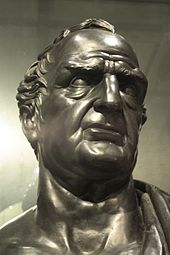
In 1948, Moore won the International Sculpture Prize at the Venice Biennale.[78] He turned down a knighthood in 1951 because he felt that the bestowal would lead to a perception of him equally an establishment figure and that "such a title might tend to cutting me off from boyfriend artists whose piece of work has aims like to mine".[62] He was, nonetheless, awarded the Companion of Honour in 1955,[79] the Social club of Merit in 1963[lxxx] and Erasmus Prize in 1968.[81]
He was a trustee of both the National Gallery and Tate Gallery.[82] His proposal that a wing of the latter should be devoted to his sculptures aroused hostility among some artists. In 1975, he became the kickoff President of the Turner Society,[83] which had been founded to campaign for a separate museum in which the whole Turner Bequest[84] might be reunited, an aim defeated past the National Gallery and Tate Gallery.[ citation needed ]
Given to the City of London by Moore and the Contemporary Art Society in 1967, Pocketknife Border 2 Piece 1962–65 is displayed in Abingdon Street Gardens, opposite the Houses of Parliament, where its regular appearance in the background of televised news reports from Westminster makes it Moore's virtually prominent slice in Britain. The ownership of Knife Edge Two Piece 1962–65 was disputed until its 2011 acquisition by the Parliamentary Art Drove.[85]
Art market [edit]
By the stop of his career, Moore was the globe's well-nigh successful living artist at auction. In 1982, four years before his death, Sotheby's in New York sold a vi ft Reclining Effigy (1945), for $1.ii million to collector Wendell Cherry-red. Although a outset tape of $iv.1 million was set in 1990, Moore's marketplace slumped during the recession that followed. In 2012, his viii-human foot bronze, Reclining Figure: Festival (1951) sold for a record £19.one million at Christie'southward, making him the 2d about expensive 20th-century British artist afterwards Francis Salary.[86]
Gallery [edit]
-

-
-

-

-
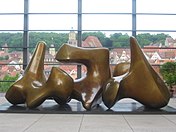
3 Piece Sculpture: Vertebrae (1968–69), Henry Moore, Kunsthalle Würth, 74523 Schwäbish Hall 2005
-

The Arch (1963/69), Henry Moore - Kunst in Schwäbisch Hall
-

Big Interior Form (1953–54), Henry Moore - Kunst in Schwäbisch Hall
-

Reclining Effigy (1982), Henry Moore - Kunst in Schwäbisch Hall
References [edit]
- ^ Grohmann, 16.
- ^ "1898–1925: Childhood and Education". Henry Moore Foundation. Retrieved 24 January 2017.
- ^ Grohmann, 15.
- ^ a b Berthoud, nineteen
- ^ Berthoud, 16–nineteen
- ^ Oxford Dictionary of National Biography
- ^ Beckett et al.
- ^ Wilkinson, Alan G. (2002). Henry Moore: Writings and Conversations. Academy of California Press. p. 41. ISBN0-520-23161-9.
- ^ "Letter to Arthur Sale, xxx April 1940". Purple War Museum. Retrieved 5 May 2017.
- ^ "Henry Moore: Life and Work". Museum of Mod Art. Archived from the original on two Feb 2009. Retrieved 28 February 2017.
- ^ Barassi, Sebastiano. "A Principal in the Making". Condign Henry Moore 2017. pp.21; 31–32
- ^ Moore, Tania. "The Nation's Collections". Condign Henry Moore 2017. pp.83–86.
- ^ Allemand-Cosneau, Claude; Fath, Manfred; Mitchinson, David (1996). Henry Moore. Nantes: Musée des Beaux Arts. p. 63. ISBN3-7913-1662-1.
- ^ Berthoud, 61–two
- ^ "Henry Moore: Biography 1916–1925". Henry Moore Foundation. Archived from the original on i February 2009. Retrieved 24 September 2008.
- ^ Cork, Richard (1985). Art Beyond the Gallery in Early 20th Century England: In Early 20th Century England. Yale University Press. p. 249. ISBN0-300-03236-6.
- ^ Berthoud, 88
- ^ Moore, Henry (2002). Henry Moore-- Writings and Conversations. ISBN978-0-520-23161-0.
- ^ Berthould, pp.98–101
- ^ "Henry Moore: Sculptor". Modernism 101. Archived from the original on ten December 2008. Retrieved 22 September 2008.
- ^ Berthoud, pp.123–4
- ^ Grohmann, 30.
- ^ "The Seven and Five Gild". Tate. Archived from the original on 26 July 2014. Retrieved 4 September 2008.
- ^ Rojas, Laurie (30 October 2013). "Henry Moore Revisits Espana". The Art Paper. Archived from the original on three November 2013.
- ^ Berthoud, p.161
- ^ Berthoud, 172
- ^ Beckett et al., 6.
- ^ Luke, Ben (20 May 2014). "Civilization: the passions and prejudices of Kenneth Clark". Evening Standard . Retrieved 12 June 2020.
- ^ "Insight at end of the Tunnel". Tate. Archived from the original on 9 April 2009. Retrieved sixteen Baronial 2008.
- ^ a b Brain Foss (2007). State of war paint: Art, War, Country and Identity in Britain, 1939–1945. Yale University Press. ISBN978-0-300-10890-three.
- ^ Fine art from the Second World War. Imperial State of war Museum. 2007. ISBN978-ane-904897-66-8.
- ^ Berthoud, 192–193
- ^ "Henry Moore". Guggenheim Collection. Retrieved 28 Feb 2017.
- ^ "Henry Moore: The Human Dimension". HMF Enterprises, 1991. 83. ISBN 0-85331-610-iv
- ^ Beckett et al., 96.
- ^ Berthoud, 221–222
- ^ Berthoud, 261
- ^ Wilkinson, 275.
- ^ "Moore, Henry". UNESCO. Retrieved on 16 Baronial 2008.
- ^ Anthony Caro. Tate exhibition catalogue, 2005. Retrieved on twenty September 2008.
- ^ Wentworth. tate.org.uk. Retrieved on xx September 2008.
- ^ 3:36 p.m., 2 December 1967. In: McNally, Rand. "Illinois; Guide & Gazetteer". Illinois Sesquicentennial Committee. University of Virginia, 1969. 199.
- ^ Beckett et al., 221.
- ^ Sachs, Robert G. "Henry Moore, sculptor". In "The Nuclear Chain Reaction-Twoscore Years Subsequently". University of Chicago. Retrieved on 11 November 2007. Archived 13 November 2007 at the Wayback Machine
- ^ Enscripted on the plaque at the base of the sculpture.
- ^ Chamot, Mary; Farr, Dennis; Butlin, Martin. "Henry Moore Archived 31 Jan 2009 at the Wayback Machine". "The Mod British Paintings, drawings and Sculpture", Volume Two. London: Oldbourne Press, 1964. 481. Retrieved on 5 September 2008.
- ^ Kennedy, Maev. "A hush falls over Henry Moore country". The Guardian, 22 April 1999. Retrieved on 24 September 2008.
- ^ "GHDI – Image". ghi-dc.org.
- ^ Alexander Davis, 1986 – 1991, Volume 4 of Henry Moore Bibliography, Alexander Davis, Henry Moore Foundation, 2009, p. 140, ISBN 0-906909-10-iv
- ^ "The Hole of Life". Tate Magazine, Outcome 5, Autumn 2005. Retrieved on six September 2008.
- ^ Day, Elizabeth. "The Moore legacy". The Observer, 27 July 2008. Retrieved on 4 September 2008.
- ^ Lawrence Sabbath (v October 1985). Prove chance to view "20th-century Michelangelo" (interview with Ann Garrould). The Montreal Gazette. Accessed September 2013.
- ^ Berthoud, pp.92–93
- ^ Berthoud, pp.280–282
- ^ a b Causey, 34.
- ^ Morris, Frances. "Paris Post War: Art and Existentialism 1945–55". Tate Gallery, 1993. ISBN i-85437-124-X
- ^ Causey, 71.
- ^ Ann Jones (2007). Geometry of Fear: Works from the Arts Council Collection Archived xxx June 2015 at the Wayback Machine (exhibition leaflet). London: Southbank Centre. Accessed half-dozen May 2017.
- ^ Caro biography Archived one February 2016 at the Wayback Machine. anthonycaro.org. Retrieved on 4 September 2008.
- ^ "Phillip Male monarch Archived 31 May 2008 at the Wayback Machine". sculpture.org.uk. Retrieved on half-dozen September 2008.
- ^ "Isaac Witkin". The Times, 10 May 2006. Retrieved on 29 August 2008.
- ^ a b "The Bronze Historic period". Tate Mag, Issue 6, 2008. Retrieved 23 Baronial 2008.
- ^ Foundation, Henry Moore. "About the Foundation". Henry Moore Foundation . Retrieved 29 November 2020.
- ^ David Wilcock (thirteen July 2012), Henry Moore sundial stolen from former garden The Independent.
- ^ a b Statuary Henry Moore piece of work stolen from sculpture park Evening Standard, 13 October 2013.
- ^ "Missing Henry Moore bronze statue 'worth £3m'". bbc.co.uk. 13 Oct 2013. Retrieved 15 October 2013.
- ^ Carol Vogel (5 November 2012), British Art World Figures Protestation Possible Sale of a Henry Moore New York Times.
- ^ Ian Youngs (five Oct 2012), Council to sell Henry Moore sculpture BBC News.
- ^ Dalya Alberge (iii November 2012), Britain's cultural elite battles to halt auction of Henry Moore sculpture The Guardian.
- ^ "Unfinished Business: Mark Wilsher on view from 26 July Archived 6 October 2008 at the Wayback Auto". Henry Moore Foundation, 2008. Retrieved on 22 September 2008.
- ^ Henry Moore Foundation at Perry Green
- ^ Bowcott, Owen (19 December 2005). "Lorry used to steal £3m Moore sculpture establish on housing manor". The Guardian . Retrieved 9 June 2009.
- ^ "£3m Henry Moore sculpture stolen". BBC News Online. 17 December 2005. Retrieved nine June 2009.
- ^ "Henry Moore sundial sculpture stolen from museum garden". The Guardian.
- ^ "Henry Moore sundial theft pair jailed". BBC News Online. 4 December 2012. Retrieved 3 May 2013.
- ^ Henry Moore Museum of Modern Art, New York
- ^ "The Archer – sculpture – Nathan Phillips Square". toronto.ca. Archived from the original on 12 October 2014.
- ^ "Henry Moore Archived 31 January 2009 at the Wayback Machine". Visual Arts Department, British Council. Retrieved on five September 2008.
- ^ Berthould, p.301
- ^ Berthould, p.302
- ^ Berthould, p.397
- ^ Chamot, Mary; Farr, Dennis; Butlin, Martin . "Henry Moore OM, CH ". From The Modern British Paintings, Drawings and Sculpture, London 1964, Two. Reproduced at Tate.org. Retrieved on 21 August 2008.
- ^ "J.1000.W. Turner". Turner Club. Retrieved on 16 August 2008.
- ^ "Turner Collection". Tate Gallery. Retrieved on nine August 2008.
- ^ "Conservation of Henry Moore sculpture to begin". London. 11 February 2013.
- ^ Colin Gleadell (13 Feb 2012), Modern sales review: when Moore ways more The Daily Telegraph.
Works cited [edit]
- Beckett, Jane; Russell, Fiona (2003). Henry Moore: Space, Sculpture, Politics. Burlington, Vermont: Ashgate. ISBN0-7546-0836-0.
- Berthoud, Roger (2003). The Life of Henry Moore (2 ed.). Giles de la Mare. ISBN978-one-900357-22-7.
- Causey, Andrew (1998). Sculpture Since 1945 . Oxford: Oxford University Press. ISBN0-19-284205-6.
- Grohmann, Volition (1960). The Art of Henry Moore. New York: H. Due north. Abrams.
Further reading [edit]
- Darracott, J. (1975). Henry Moore War Drawings.
- Feldman, Anita (2009). Henry Moore Textiles. Surrey: Lund Humphries. ISBN978-1-84822-052-2.
- Feldman, Anita (2013). Henry Moore: Large Late Forms. London: Gagosian.
- Feldman, Anita (2014). Body & Void: Echoes of Moore in Gimmicky Art. Perry Green: The Henry Moore Foundation. ISBN978-0-906909-32-4.
- Feldman, Anita; Pinet, Hélène; Moore, Mary; Blanchetière, François (2013). Moore Rodin. Perry Green: The Henry Moore Foundation. ISBN978-0-906909-31-7.
- Feldman, Anita; Woodward, Malcolm (2011). Henry Moore Plasters. London: Regal University of Arts. ISBN978-one-907533-xi-two.
- Hedgecoe, John (1998). A Awe-inspiring Vision: The Sculpture of Henry Moore. Collins & Brown. ISBNane-55670-683-9.
- Kosinski, Dorothy, ed. (2001). Henry Moore: Sculpting the 20th Century. New Oasis: Yale University Press.
- Mitchinson, David; Feldman Bennet, Anita (2002). Moore: The Graphics. ISBN0-906909-26-0.
- Moore, Henry (1986). Henry Moore: Model to Monument. New York: Kent Art. ISBNone-878607-21-9.
- O'Reilly, Emerge; Oliver, Clare (2003). Henry Moore . Scholastic Library. ISBN0-531-16643-0.
- Seldis, Henry J. (1973). Henry Moore in America . Praeger.
- Sylvester, David (1968). Henry Moore. London: Arts Quango of Great Britain.
- Henry Moore: At Dulwich Movie Gallery. Scala. 2004. ISBNi-85759-352-9.
External links [edit]
- Henry Moore Foundation website
- Henry Moore collection at the Israel Museum.
- "The Enigma of Henry Moore" by Brian McAvera. Sculpture Mag, July/Baronial 2001: Vol. twenty, No. 6.
- BBC article with annal pic of Moore at piece of work
- 3D model of Recumbent Figure (1938) from Tate
- The UNESCO Works of Art Collection
- An Intimate Moore, Tom Freudenheim, The Wall Street Journal, 30 June 2010
- Henry Moore at Kew, 2007
salvadortinglaceen.blogspot.com
Source: https://en.wikipedia.org/wiki/Henry_Moore
Belum ada Komentar untuk "A Twentiethcentury Sculptor Known for Exploring Open and Closed Forms in His Art Is"
Posting Komentar